This is the world’s most famous theater — and a must-see for any Hollywood tourist.
It was first opened in 1927, and since then, it’s been visited by millions of people. There are plans to improve its facilities and turn it into a state of the art entertainment complex. Some are even lobbying to make it the permanent home of the Academy Awards.
Until that happens, guests are already happy to look at the handprints outside, especially since there’s no charge. You can also watch some of Hollywood’s first motion pictures. (The sound quality is incredible, and the screen really makes you think that you’re jumping into another era.)
True Hollywood trivia addicts can look at the full list of handprint ceremonies or even buy the book.
.
Comment (1)

Gower Street may not be the most popular or well known areas of Hollywood, but it’s played a big role in its history. This humble road was home to the very first motion picture studio was built here, the Christie Studios, founded by Al Christie in 1911. It later became the location of major players like Paramount Pictures, Sunset-Gower Studios (occuping the former lot of Columbia Pictures). The Oz Film Manufacturing Company also used to stand here, before it was bought out by Paramount.
Gower St’s Columbia Drugstore was also the favorite hangout of young movie stars who loved the soda fountain. They would also buy their hometown magazines and newspapers from the vendor outside the store.
So who’s Gower? He was not a producer, or an actor. Actually, he was a farmer who brought in the area’s first farming equipment — back when Hollywood was mostly pastureland. In the 1930s Hollywood actors called the place “Gower Gulch”. It was the height of the Western films and many extras would walk around in their cowboy costumes. A mall named “Gower Gulch” now stands here.
Comment (0)

You’d never guess it, but we owe the rise of Hollywood to the ego of Thomas Edison.
Originally the movie capital was New York and Chicago, and Thomas Edison — whose inventions had helped spearhead the film industry — wanted to create a monopoly that would give him control over distribution, exhibition, and pricing. He called this monopoly “The Trust.” But independent artists wouldn’t have anything of it. So they moved to Los Angeles.
Los Angeles was perfect for film making. The mild climate and sunshine allowed outdoor shoots in fantastic settings, significantly lowering costs of making indoor sets. There was a big and cheap labor market.
Back in New York, German Carl Laemmle delivered a big blow to the movie giant Edison had created. He introduced the star system, a direct contract to “The Trust’s” policy of cloaking actors in anonymity. Laemmle pirated actress Florence Lawrene and mobilized a huge publicity campaign. The “celebrity” was born.
Back in Hollywood, David Horsley established the first studio (The Nestor Film Company), quickly followed by 15 other companies. Then, Cecil B. DeMille (photograph above), Jesse Lasky and Samuel Goldwyn introduced the first feature-length film, “The Squaw Man.” Hollywood’s Golden Era had begun.
Comment (0)

Hollywood producers are willing to invest millions on films if it can bring in the audience — you got to spend money to make some money, right?
That’s probably how the accountant of SpiderMan 3 justified a budget of $258 million, giving it one of the highest price tags of any movie before or after its release. But it’s not really the most expensive movie if you factor in inflation.
Cleopatra cost about $ 44 million, a princely sum considering it was filmed in 1963 (that would be worth about $295 million today). It is the most epensive movie made in HOllywood.
However, the Soviet movie “War and Peace” based on the Tolstoy classic cost $ 100 million in 1968, and took over 7 years to finish. It’s won the Guiness record for the largest battle scene (about 120,000 soldiers). If you compute for inflation, that would be worth abot $ 500 million today.
Comment (0)

Hollywood doesn’t have its own government, but because of its special status as the movie capital of the world, it does have an honorary mayor. And that is Johnny Grant, who’s held the job for decades. .
Grant is a radio personality and TV producer, who gained fame for the way he covered the murder trial of Irby Holmes. He was the first to give periodic live reports of the trial, after he managed to persuade the judge to let him stay by the doorway. Until then, no live microphone was ever permitted in a courtroom.
The defendant was found guilty of murder and sentenced to death. But the part-time preacher begged the judge to deliver one last sermon. No go—but he was allowed to write it, and Grant later read that on air. Grant also hosted the first national telethon, and appeared in a few films. He won the Emmy Award twice.
Grant was chosen as Mayor, however, for his strong community involvement: he was a National Guard volunteer (receiving the Order of California twice), and has chaired the Fire Commission, Social Service Commission, and Police Commission.
Comment (0)

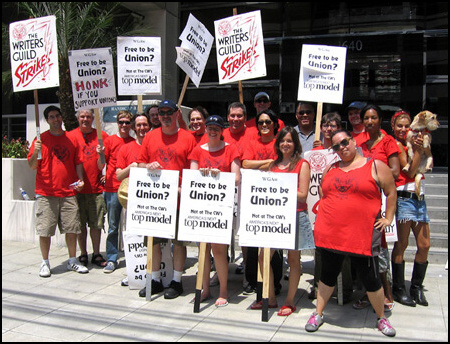
With the Hollywood writers strike in full swing, the big question is how it’ll affect TV and viewing as whole. For that we can turn to history. The last time writers walked off the set was in 1988. Nobody took it seriously, thinking (like previous protests) it would all be over in a few weeks. Actually, it lasted 6 months. And it was hell.
Network TV lost 9% of its audience, the Fall season was pushed back, and even after the writers were wooed back to work, 10% chose not to return. Scripts were in such high demand stations actually bid for it (very expensive). And, due to the slowdown of production, networks had to lay off other production crew — caterers, set designers, shipping services, and all the auxiliary services that make up the million-dollar industry. In those six months, Los Angeles’ economy lost hundreds of millions of dollars.
Clearly, there’s more at stake than whether or not we get a new episode of Leno.
Comment (0)

Before the studios and the stars, Hollywood was pastureland — dotted by citrus groves, barns, and large herds of cows (and the occassional camel). That all changed in the 1920’s. The film industry had boomed, and the large barns were easily converted into studios. Real estate companies tried to take advantage of the sudden growth, and one erected a very large (and at that time considered very tacky) ad: the word “Hollywood” displayed on the hills.
The movie industry survived the Great Depression and two world wars, but the sign barely did. In 1976 some very bored truants manipulated it to read “Hollyweed”. Two years later, another group edited it to “Holywood” (because of a visit by Pope John Paul). In the 80s, during the Iran contra scandal, it was once again vandalized into “Ollywood”.
The sign was falling apart, sparking a community-wide “Save the Sign” campaign. About $250,000 was raised — and now, it stands proud.
Comment (0)